
18/10/2024 · IsabelM
+75,000 Shares of Autoestrada do Algarve (A22) in Insolvent Construction Company Auction
The electronic auction of shares in Sociedade Autoestrada do Algarve - Via do Infante (AAVI, S.A.) runs until October 31 and represents a unique opportunity for investors interested in the road infrastructure sector in Portugal. This auction puts up for sale + 75,000 shares of the concessionaire

The electronic auction of shares in Sociedade Autoestrada do Algarve - Via do Infante (AAVI, S.A.) runs until October 31 and represents a unique opportunity for investors interested in the road infrastructure sector in Portugal.
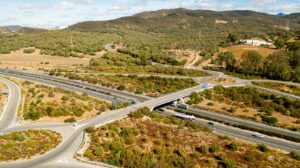
This auction puts up for sale over 75,000 shares of the concessionaire, which is responsible for the management and operation of one of the main motorways in the Algarve, the A22, also known as Via do Infante.
Via do Infante is a strategic route that connects the entire Algarve region, facilitating the movement of residents, tourists, and the transport of goods. With the road infrastructure sector constantly evolving, the sale of these shares may attract investors looking to diversify their portfolios and participate in a market that plays a fundamental role in the regional and national economy. The auction also reflects the dynamism of the concession market in Portugal, highlighting opportunities for new investors in the segment.

Structure, Objectives, and Revenue Sources of the Concessionaire
In May 2000, a concession contract was signed between the Portuguese State and Autoestrada do Algarve – Via do Infante – Empresa Concessionária AAVI, S.A. under a SCUT regime for a period of 30 years, ending in May 2030, through an international public tender for the granting of a concession for the design, planning, construction, increase in the number of lanes, operation, exploitation, and maintenance, under a toll-free regime for users, of certain motorway sections and associated road networks in the Algarve.
The concession object also includes the design, planning, construction, financing, maintenance, and operation of the IC4 Lagos – Lagoa and IC4 Lagoa – Alcantarilha sections, as well as, for maintenance and operation purposes, the IC4 Alcantarilha – Guia and IP1/IC4 Guia – Vila Real de Santo António sections.
The Concessionaire also benefits from revenues resulting from the sub-concession of service areas and from insurance company indemnities for damage caused to the motorway by vehicle accidents, and is further remunerated for operation and maintenance services, values that are recognized as service fees.
Opportunities and Challenges for Concessionaires with the End of Tolls in 2025
What does the end of tolls mean for concessionaires?
At the time of the concession contract signing in 2000, the Autoestrada do Algarve (A22) benefited from a SCUT regime. In 2011, for deficit containment reasons, tolls were introduced on this motorway.
Thirteen years later, in June 2024, the Assembly of the Republic approved the end of tolls on former SCUTs, which will take effect in 2025, following the approval of the State Budget. Tolls represent an important part of the concessionaires' funding model, which use these resources to cover operational costs, maintenance, and the recovery of investments made in the construction and improvement of infrastructure.
However, the end of tolls potentially leads to an increase in traffic, which may generate indirect revenues. The higher flow of vehicles on the motorways may generate more activity in service areas, benefiting food and beverage companies, fuel stations, and other associated services.
This situation also creates an opportunity for concessionaires to explore new business models, such as partnerships with technology companies for the installation of electric vehicle charging stations, or the development of infrastructure that leverages the high vehicle circulation to generate alternative revenues.
At the same time, this set of factors may translate into an economic strengthening of the regions adjacent to the motorways, contributing to a more robust and dynamic ecosystem, benefiting local populations and promoting regional development.
Another positive aspect is the improvement of the public image of the concessionaires. The elimination of tolls may be seen as a response to drivers' demands for more accessible and efficient transport, which may increase customer satisfaction and loyalty.
Furthermore, the reduction in operational costs associated with toll collection, such as system maintenance and staff, may free up resources that can be invested in improvements to road infrastructure.
In summary, the end of tolls may make concessionaires more attractive to investors, due to increased traffic, improved customer satisfaction, reduced operational costs, and regional development, resulting in opportunities for expansion and infrastructure improvement.
What are the consequences of the end of tolls for the revenues of concessionaires?
The end of tolls in 2025 in Portugal does not necessarily mean an immediate reduction in revenues for concessionaires, due to certain contractual provisions that guarantee financial stability. Regardless of traffic flow, concessionaires have a contractual and unconditional right to receive the value related to the toll collection service, as well as remuneration for the construction and operation services of the motorways.
This financial mechanism ensures that companies continue to be compensated for the service provided, even if the toll collection model is altered or abolished. In addition, the existence of contractual safeguards protects concessionaires from demand variations, isolating them from direct revenue impacts caused by fluctuations in the number of vehicles using the roads.
This stability is reinforced by the possibility of extending the concession beyond 2030, which increases the value of the shares and their attractiveness to investors. It is also worth noting that, as loan repayments are scheduled to end by 2027, the concessionaire has time to adapt its strategies and seek new forms of financing or partnerships that compensate for the loss of toll revenue, thereby ensuring that it can continue to operate and grow sustainably even after the changes in the toll collection system take effect.
In short, it is important to note that certain contractual provisions guarantee the financial stability of the concessionaires, which translates into a low-risk and profitable investment.
Article by Isabel Meireles by LEILOSOC® dated October 18, 2024
#ações#autoestrada do algarve#direitos#leilão eletrónico#oportunidade de investimento
Keep reading
See all
26/05/2025 · IsabelM
Urban Rehabilitation: Is It Worth Investing in the Centre of Porto?
Urban rehabilitation is, today, one of the smartest and most sustainable ways to invest in the real…
Read more: Urban Rehabilitation: Is It Worth Investing in the Centre of Porto?
16/04/2025 · IsabelM
7 Reasons to Invest in Oeiras Valley
Oeiras stands out as one of the main economic development hubs in Portugal, due to its unique condit…
Read more: 7 Reasons to Invest in Oeiras Valley
05/02/2025 · IsabelM
FERRARI F8: A STORY OF TRADITION AND INNOVATION
Ferrari F8 Tributo · 2021 The Ferrari F8 represents the Tradition and Innovation that define the ess…
Read more: FERRARI F8: A STORY OF TRADITION AND INNOVATION